Slaves of the Baker

Slavery in the Roman Empire took many forms. Some slaves were domes­tics who were as good as part of the family, and might look for­ward to earning or being given their freedom by grate­ful masters. But many were indus­trial slaves, and their lives were miserable and short. In his comic fantasy Meta­mor­phoses, com­monly known as The Golden Ass, Apuleius describes the slaves and animals at a bakery. His hero, Lucius, has been magically turned into an ass, and has been bought by the baker to join the horses who turn the mills. This is not a little neigh­bor­hood baker’s shop. This is a huge fac­tory opera­tion, where miser­able slaves and even more miser­able horses toil in the hot smoke to make bread on an indus­trial scale. The trans­lation is in the vigorous Eliza­bethan English of William Adlington.


O good Lord what a sort of poor slaves were there, some had their skin black and blue: some had their backs striped with lashes, some were covered with rugged sacks, some had their mem­bers only hidden: some wore such ragged clothes that you might per­ceive all their naked bodies, some were marked and burned in the fore­heads with hot irons, some had their hair half clipped, some had locks on their legs, some were ugly and evil favored, that they could scarce see, their eyes & faces were so black & dim with smoke, like those which fight to­gether in the sands, & know not where they strike by reason of dust: And some had their faces all mealy, but how should I speak of the horses my com­pan­ions, how they being old & weak, thrust their heads into the manger: they had their necks all wounded and worn away: they rattled their nos­trils with a con­tin­ual cough, their sides were bare with their harness and great travail, their ribs were broken with beating, their hoofs were bat­tered broad with inces­sant labor, and their skin rugged by reason of their lankness.

From The Golden Ass, Book IX, translated by William Adlington (with modernized spelling).
Meanings of “Africa” in Ancient Roman Writers

What did “Africa” mean to an ancient citizen of the Roman Empire?

It seems as though the name means three or possibly four different but related things, and it’s helpful to sort them out carefully:

1. The province called “Africa.” This changes over time, because the Empire was always reorganizing its provinces. When the Latin Church Fathers say “Africa,” it means this more often than not. Often they specify “Africa and Numidia” to indicate that whole region.

2. Northern Africa outside of Egypt.

2a. Northern Africa outside of Egypt and Libya, so that to include all of northern Africa, the writer says, “Egypt, Libya, and Africa.” In this division, I think “Africa” basically means “Latin-speaking Africa.”

3. More or less what we mean by Africa today. The ancients didn’t really have our idea of a “continent,” but the world was divided into three parts, In Greek, the word “Libya” takes the place of Africa here. For example, in Eusebius’ Life of Constantine (Book III, Chapter 7): “In effect, the most distinguished of God’s ministers from all the churches which abounded in Europe, Libya, and Asia were here assembled” (namely, at the Council of Nicæa).

Sometimes we see the same writer using two different meanings in the same book.

Theodoret quotes Constantine’s letter about Easter: “I engaged that you would be ready to adopt it likewise, and thus gladly accept the rule unanimously adopted in the city of Rome, throughout Italy, in all Africa, in Egypt, the Spains, the Gauls, the Britains, Libya, Greece, in the dioceses of Asia, and of Pontus, and in Cilicia,…” [Ecclesiastical History, Book I, Chapter 9.] Here we have the division of northern Africa into Africa, Libya, and Egypt. 

But later in the same book, Theodoret writes about Constantine’s success: “For this reason he was blessed with the special protection of God, so that although he held the reins of the whole of Europe and of Africa, and the greater part of Asia, his subjects were all well disposed to his rule, and obedient to his government.” [Ecclesiastical History, Book I, Chapter 24.] This is the division of the world into three parts, with Africa one of the parts, obviously including Libya and Egypt.

The African Accent in Latin

The Roman province of Africa was noted for producing famous writers and orators in Latin—Apuleius and Augustine among them. But did Latin-speaking Africans have an identifiable regional accent?

It seems that they had, at least by the late 300s. Here are two Latin writers—one African, one not—who both mention it. Augustine, the African, also mentions one of the particular features of the accent.

Augustine: …why should a teacher of godliness who is addressing an unlearned audience shrink from using ossum instead of os, if he fear that the latter might be taken not as the singular of ossa, but as the singular of oraseeing that African ears have no quick perception of the shortness or length of vowels? (On Christian Doctrine, Book IV, Chapter 10.)

Jerome: There was a man at Rome who had an African, a very learned man, as his grammar teacher; and he thought that he was rising to an equality with his teacher because he copied his strident voice and his faulty pronunciation. (Apology Against Rufinus, Book III, chapter 27.)

The Ancient Pronunciation of “Pittsburgh”

Today we pronounce it “PITTS-burg.”

I’ve seen respectable historians who suggest that, at the founding, it was pronounced “PITTS-burrah,” as in Edinburgh, since Pittsburgh was named by a Scotsman.

But we can find some evidence that, two hundred years or more ago, country people in Western Pennsylvania—not necessarily the people in town themselves—pronounced it “PITTS-berry.”

In the early 1800s, the distinctive Western Pennsylvania dialects had not yet developed; country people in western Pennsylvania spoke the way rural people all over the North spoke. In northern American rural speech of the early 1800s, the schwa sound at the end of a word was often replaced by the -y sound. Artemus Ward’s comical schoolmaster quotes printing-specimen Latin: “Quosque tantrum, a butter, Caterliny, patent nostrum!” (The original is “Quo usque tandem abutere, Catilina, patientia nostra?” from Cicero’s First Catiline Oration, which was ubiquitous as filler text in typefounders’ and printers’ specimen books.)

Thus, very probably, the pronunciation “PITTS-burrah” would become “PITTS-berry.”

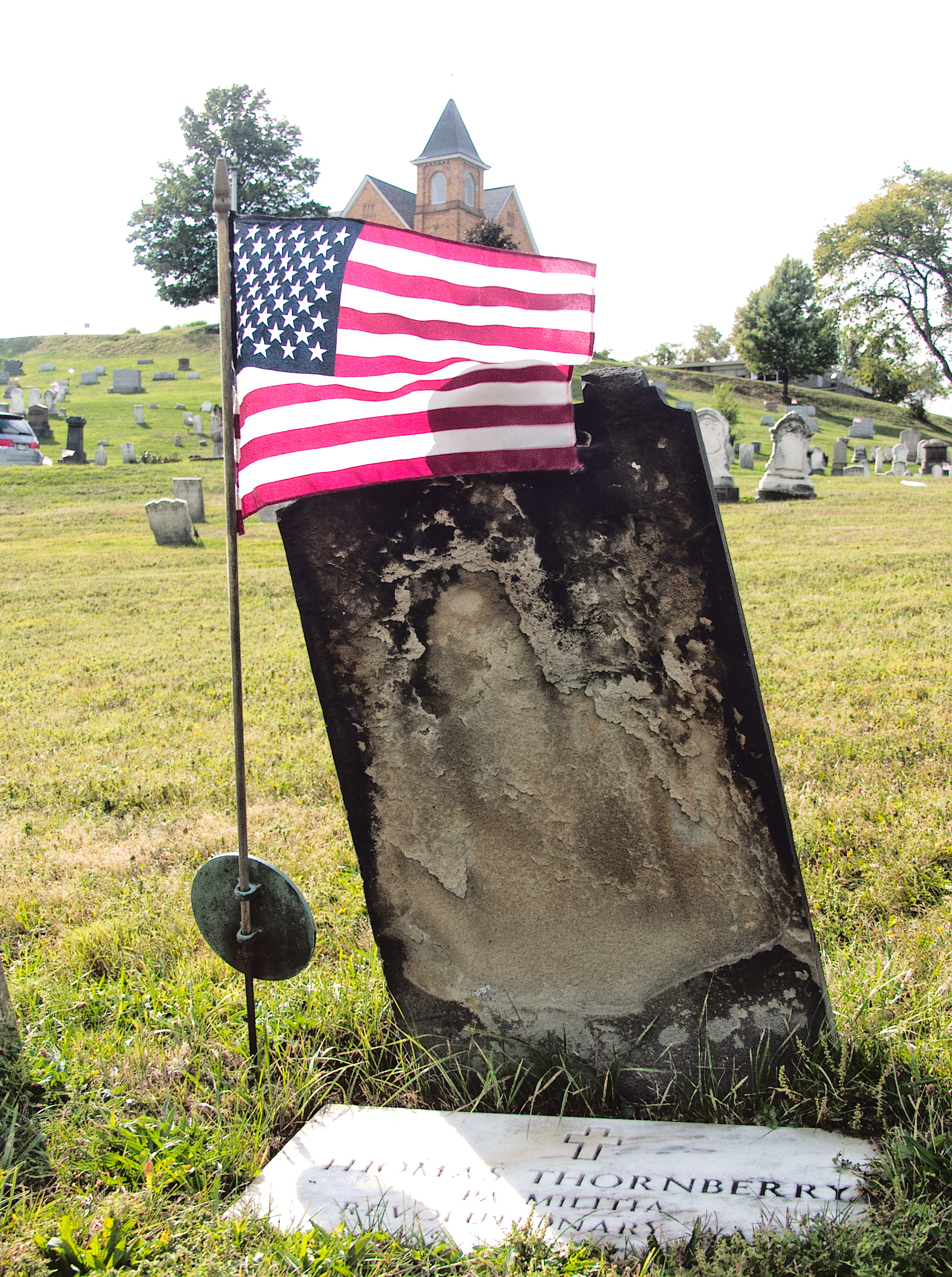
So far this is only speculation. But we can find a tiny piece of evidence in the Union Cemetery, an old churchyard in Robinson Township, which would have been well out in the country in the early 1800s.

This stone is regrettably so badly damaged that we can read nothing on it. But a plaque in front of the stone identifies it as belonging to Thomas Thornberry, a Revolutionary War veteran. Presumably the name is entered thus in the burial records.

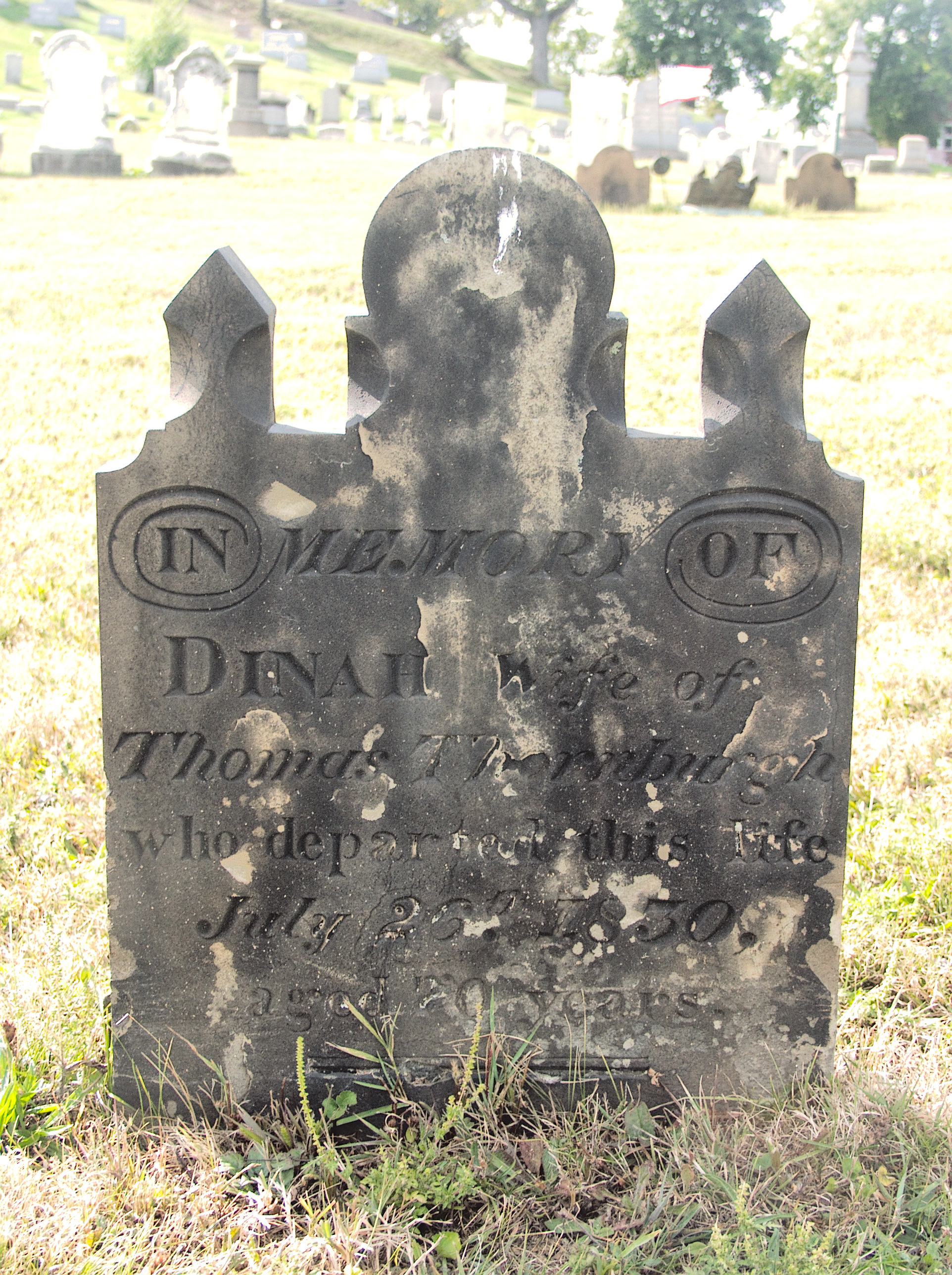
Beside his stone is a legible stone for a woman who is obviously his wife.

IN MEMORY OF
DINAH Wife of
Thomas Thornburgh

who departed this life
July 26th, 1830,
aged 70 years.

And here is our evidence. Inscriptions on tombstones of the early 1800s around here are commonly semi-literate; it is common to find variant spellings of the same name. Here we have the same name spelled “Thornburgh” and “Thornberry.” Now, it is not possible to imagine the name “Thornberry” being pronounced “THORN-burg,” but it is quite possible to imagine “Thornburgh” passing from “THORN-burrah” to “THORN-berry” in the rural American accent of two hundred years ago. And if that is the case, then we have evidence that, in western Pennsylvania, the spelling “-burgh” indicated the sound “-berry” at least to some residents as late as 1830.

But the residents of the borough themselves might have regarded that pronunciation as the mark of a hick. I’ve been reading Hugh Henry Brackenridge’s Incidents of the Insurrection in the Western Parts of Pennsylvania in the Year 1794, which is a riveting story of the Whiskey Rebellion told by a very clever man. One of the things you can’t help noticing is the wide cultural difference that already existed between Pittsburgh and the surrounding countryside. Pittsburgh was already developing urban sophistication of a sort, and the country people hated it. How will we prevent them from burning Pittsburgh?—that’s the constant anxiety of people in town. It was clear that a large portion of the mob was ready to use the revolt against the whiskey excise as an excuse to loot and destroy the borough, taking their revenge on all those people who thought they were better than honest country folk. In one telling episode, Brackenridge and his town friends have a good laugh at an illiterate notice posted by a country rebel in a tavern—only to turn and find two or three country people seething with resentment. As usual, Brackenridge saved his skin with a joke. “I turned it off suddenly, by saying, that it was no matter; he did not spell well; but he might be a good soldier, and sight well. This restored their good humour.”

All of this is speculation on top of speculation on top of a molehill of evidence. But speculation is most of what you will see here, so you might as well get used to it.