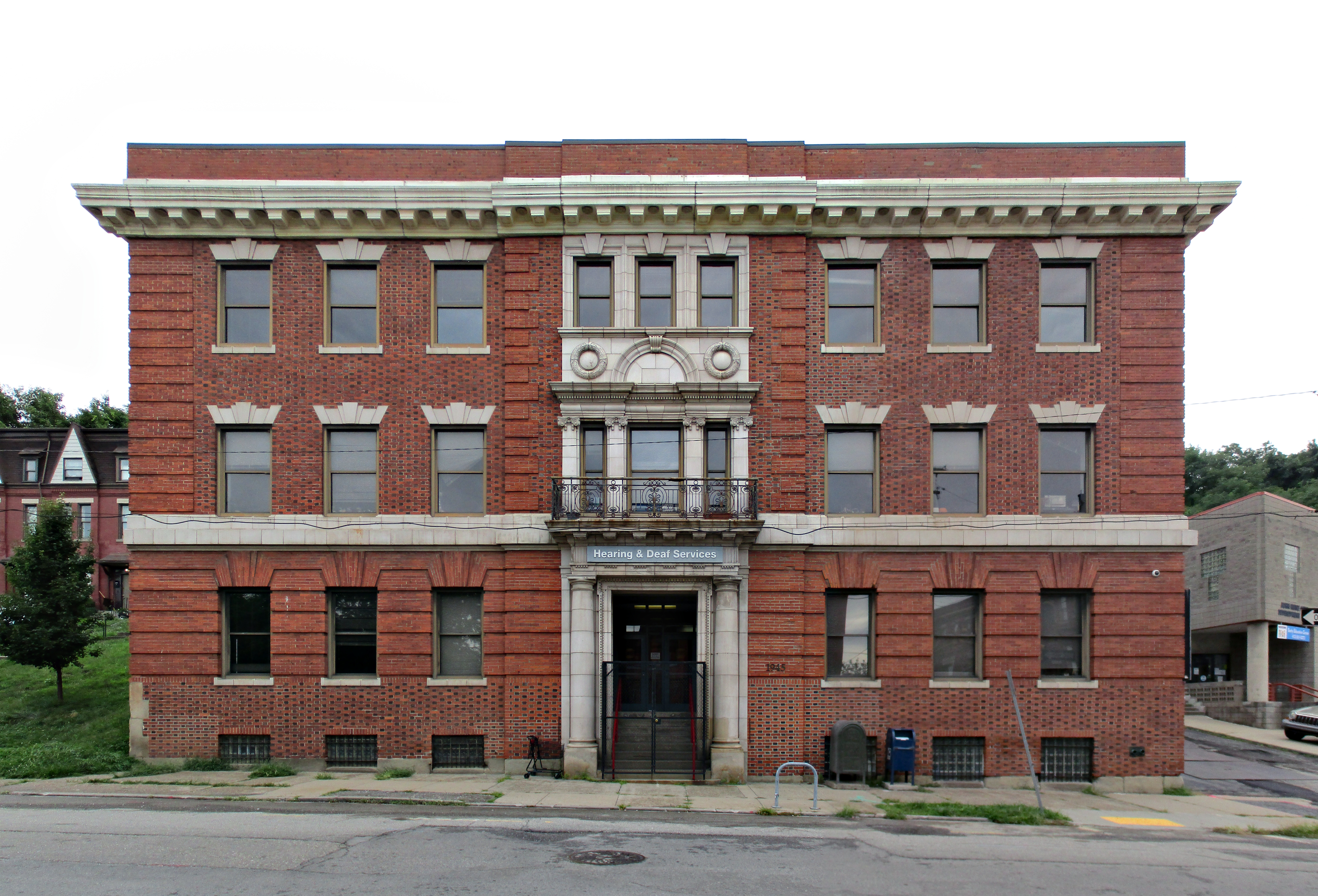
The building on Fifth Avenue still stands today, though no longer in use as a hospital.
How the idea of a hospital has changed is made strikingly clear by this description of the Eye and Ear Hospital from a 1922 history of Pittsburgh.
Located on Fifth avenue, corner of Jumonville street, is the Eye and Ear Hospital, under the auspices of a board of women managers. It had its inception at a meeting held May 20, 1895, at the home of Miss Sarah H. Killikelly, who during her lifetime was well known in the literary and historical circles of the city. A charter was secured June 22, 1895, and a location was secured on Penn avenue, but a removal was made to the present building in 1905. The first board of managers consisted of thirteen women and two physicians, eye specialists, for the medical and surgical treatment of all diseases of the eye, ear, nose and throat. The patients are divided into three classes—first, for the poor who require treatment of a character that is not necessary to detain them at the hospital; second, for the poor who require detention in the hospital, to whom free beds are allotted in the wards and a nominal charge made if they are able to pay; third, for those able to pay, private rooms are furnished, therefore the hospital is in no sense a charity; it must under its charter minister without charge to all those who suffer from any disease of the eye and ear, who are unable to pay for treatment.1
We might add that it would be interesting to survey hospitals today and find out how many of them are controlled by a board of women managers. There may be a few Catholic hospitals still nominally controlled by nuns.
In Victorian times, stage plays were straightforward affairs. You had a virtuous maiden and a sneering villain, and the plot was some contrivance by which the sneering villain would attempt to rob the virtuous maiden of her adjective. Mortgages were always useful weapons in the arsenal of a stage villain, but the better playwrights came up with more ingeniously dastardly plots than the simple but reliable mortgage-on-the-farmhouse.
By many accounts the first American to make his living as a playwright was Bartley Campbell. He wrote for theaters in Pittsburgh, whence his plays propagated across the country. They were perfectly suited to the middlebrow tastes of the American theatergoer in the later 1800s. No one’s heroines were more virtuous, no one’s villains sneerier than Campbell’s.
His most successful play by far was The White Slave, which played every stage from big-city theaters to hick-town “opera” houses for decades. It’s set in the antebellum South, and it’s about a virtuous maiden and a sneering villain who comes up with a humdinger of a wicked plot. He convinces the heroine that she is an “octoroon”—that one of her great-grandparents was Black. Under Southern laws, that makes her Black and a slave.
This poster shows the two most famous scenes from the play:
In the first, the villain has just threatened to put our heroine to work with the common field slaves unless she consents to become his favorite. In reply, she speaks the most famous and applause-gettingest line in nineteenth-century American theater: “Rags are royal raiment when worn for virtue’s sake!” The other scene is the villain’s inevitable comeuppance, in which an authority figure reveals that our heroine is a Genuine White Woman, and thus ineligible for slavery. Notice that nineteenth-century audiences did not worry about “spoilers.” They knew how the plot would come out, but they loved to see virtue in action. They came to cheer the heroine and hiss the villain.
Bartley Campbell’s plays were enormously successful, but he went mad from the stress of trying to manage a full-time playwriting career and died in an asylum at the age of 43. Let that be a lesson to all you aspiring writers out there. He is buried in St. Mary’s Cemetery in the Lawrenceville neighborhood of Pittsburgh, where he rests under an obelisk—but a Catholic obelisk, depaganized as they usually are in Catholic cemeteries by the addition of a prominent cross.
And if you look a little closer, you will recognize his epitaph:
Imagine our stage heroine—who has been trained from youth to trill her Rs vigorously—pronouncing that immortally alliterative line with a virtuous toss of her head. Imagine the audience jumping to their feet to cheer for her virtue, leaving the villain to shuffle his feet for five minutes before he can finally get on with his next threat. And then imagine one of those audience members years later wandering through the pleasant hills of St. Mary’s Cemetery and coming across this monument. In an instant the most thrilling stage performance of his life rises before his mind’s eye, and he hears that immortal line, and he says a prayer for the soul of Bartley Campbell.
And while we are imagining things, imagine a twenty-first-century play in which the heroine gives up everything for virtue’s sake, and the audience doesn’t laugh at her.
The pictures of the Campbell monument come to us by courtesy of Father Pitt, who in turn was directed to the monument by the noted Lawrenceville historian James Wudarczyk.
The earliest appearance of Cuba-You-Quit Alley on a map, in 1882.
On the subject of Cuba You Quit Way, von Hindenberg asks, “What is the large building thrown diagonally across Cuba’s line of retreat?”
Dr. Boli and Father Pitt have not been able to find out. The question is complicated. The alley was on a steep hill (it ran along the border between Uptown and the Hill District), and the map shows small frame houses (yellow) and two brick houses (red) that no longer exist. In the 1910 map by the same company, the same building is shown as red, indicating that it was made of brick or stone. Possibly the change of color indicates that it was demolished or dilapidated. It appears to belong to “V. Brusco et ux.” on the 1923 map, but it is adjacent to the Booth & Flinn brickyard, and might be one of their buildings. Since there was no zoning in the neighborhood, the whole area was a cluttered mix of modest rowhouses, businesses, small factories, and institutions. The western half of Cuba You Quit Way may not have been cut through: many streets appear on these maps that are only paper streets, or pathways through the weeds. We should add that the automobile or wagon was not welcome here: Wyandotte Street (the diagonal street at lower right) is a stairway. Probably the only way to get to those little houses on Cuba You Quit Way was on foot (which is still true of a surprising number of houses in Pittsburgh). It is easier for a pedestrian than for a car to step around the projecting corners of a building.
Of course the name of the alley is the most surprising thing about it, and it tended to attract remark when it was current. During the First World War, the Pittsburgh correspondent for The Union Postal Employee took inspiration from the name to suggest some improvements in the city’s street-naming system, which still frustrates mail carriers.
Our city scheme is not simple. The “namers” of the streets appear to favor words of topographical significance, and as a result one-half of the names refer to some degree of elevation peculiar to the section in which the street happens to be. There are dozens of “Hill Top,” “Highview,” “Hillside,“ ”Hilldales,” etc., to say nothing of a few pages of “Maples,” “Elms,” and “Ferns.” One street, however, stands forth prominently as the only one of its name in the world. I refer, of course, to “Cuba-You-Quit Alley.” At the present time, with a war in progress that makes the Spanish-American War look like a backyard scrap, the only move to commemorate the event was the changing of the name of “Kaiser Wilhelm Street” to “Marne Way.” Surely the “namer” of “Cuba-You-Quit Alley” would not hesitate to accept the suggestion that we rename some of the “Maples,“ ”Elms” and “Hills,” etc., with more appropriate titles. I suggest a few, but the inventor of the name of “Cuba-You-Quit Way” will undoubtedly be able to improve on my list: “Berlin-or-Bust Alley,” “Buy-a-Bond Terrace,” “War-Savings-Stamp Street,” “Food-Will-Win-the-War,” “Don’t-Waste-It Alley,” “Over-the-Top Avenue,” or “Carry-On Boulevard.” (The Union Postal Employee, January, 1918.)
In at least one way the postal employee’s suggestion was implemented. Shortly after the Great War, a new automobile highway was opened clinging to the cliff above the Monongahela, and it was given one of the most audaciously grandiose names ever applied to an American street: “The Boulevard of the Allies.” Unlike New York’s Avenue of the Americas, the Boulevard of the Allies is so called by ordinary Pittsburghers; and furthermore Second Avenue downtown was renamed as an extension of it, so that to navigate the avenues downtown you have to learn to count in Picksburgh dialect: one, Allies, three, four, Forbes, five, Oliver, six, seven.
But did Cuba-You-Quit Way get its name from the Spanish-American War? No; it first appears on maps in 1882. The name appears to be a folk etymology: that is, a popular but incorrect explanation of the derivation of a term. The Post-Gazette told the story of Cuba-You-Quit Way a few years ago. It seems the alley was named for a Chippewa woman named Cub-bayou-quit (there was no settled spelling of her name), who married a well-to-do Pittsburgher. She married him in a Chippewa ceremony; but when, as a widow, she tried to claim property worth millions of dollars in 1874 money, the current owners claimed that Chippewa marriage did not count in Pennsylvania law. Apparently the case was such a sensation that it was in everyone’s minds for months, and some city planner attached her name to a new alley, which does not appear on an 1872 map but does on an 1882 map as “Cuba-You-Quit Alley.” The rule that there are no “alleys” in Pittsburgh was not in force until the early twentieth century; we still find some ancient street signs marking alleys that are “ways” on modern maps.
Street sign for Larkins Alley (now Larkins Way) on the back of St. Casimir’s Church, South Side.
The Post-Gazette says that the name of Cuba-You-Quit Way was changed to Cuba Way in 1926, and adds that “it no longer exists.” That is not quite correct. The eastern section of Diaz Way, a narrow and nearly but not quite abandoned alley, is the old Cuba-You-Quit Alley.
Diaz Way probably has an interesting history, too. It appears as “Davis Alley” in 1872, the earliest map on which we have been able to find it (it does not appear in 1862 or before). It is still Davis Alley in 1882, but the name has changed to Diana Alley in 1890. It still appears as Diana Alley in 1910, but as Diaz Way in 1923.
Dr. Boli often wanders into back alleys of history, but seldom so literally as he has done today.