“English compositors invariably seem to deal with French accents as confectioners do with caraway seeds—put them into a sieve and shake them out promiscuously.”
——Letter to A. E. Chalon, 1855.
“English compositors invariably seem to deal with French accents as confectioners do with caraway seeds—put them into a sieve and shake them out promiscuously.”
——Letter to A. E. Chalon, 1855.
Sometimes one runs into a perfect crank, and then one simply has to enjoy the crankiness. Here we have an essay that parades its crankiness in its title:
Macedonian – The European Mother Tongue, with dictionary of ancient words still present in today Macedonian language. The all-inclusive PIE substratum of Pelasgo-Proto-Macedonic, i.e. Nashinski (Lat. Nostratic) and its 15,000 years old continuum with explained etymological phonologies from various sources and online dictionaries link-citations. By Basil Chulev, 2018.
The author has typical Slavic difficulties with English, particularly the use of articles. But he makes himself understood well enough. He is going to argue that Macedonian, the Slavic language spoken in North Macedonia, is the ancestor of all European languages.
The preface begins with a sensible-sounding explanation that this paper is meant for the non-technical reader, but it veers into crank territory pretty quickly.
The given explanatory notes are prevalently etymological or lexicographical, free of western Eurocentric political-biased theories. Examples of how one and the same mislead is used or not to explain the continuity flow of the Macedonic languages are shown on the page 16, and further in the very dictionary below, in function to expose and debunk the western Eurocentric hotchpotch linguistics.
The hallmarks of a crank are all here in two sentences: the notion that a whole scientific discipline is wrong and that it is kept wrong by knowing conspirators; the claim that I alone (or I the member of a small minority) see this conspiracy for what it is; and the palpable anger that descends almost instantly to name-calling.
But does Mr. Chulev have a legitimate argument? We are inclined to dismiss him simply because he comes from a tiny country that most of us hardly think of. We have heard Lithuanians say that Lithuania is the fountain of all civilization. We have heard similar claims from certain Pittsburghers. But the fact that local chauvinism is a common phenomenon does not invalidate an argument that Indo-European languages originated in the Balkans. They had to originate somewhere, and doubtless the people who live there now, wherever that is, are intensely proud of their homeland.
So what kind of argument will our author make? We turn to the introduction.
He begins by stating the obvious fact that there is a family of Indo-European languages all related to one another. Then he makes an argument that the name of Macedonia would mean “World of Mother” in Sanskrit, and adds that “Boševski and Tentov (2005) have deciphered the syllabic ligature MoDeA (acronym of Mo-De(tsa)-A) as ‘Mother-Children-1st’ (i.e. the ‘Mom of Children of the Great 1st One’).”
We do not pretend to understand what this is supposed to mean, other than to say that providing a “decipherment” that is borderline nonsense, and then interpreting it by connecting the ideas with random explanatory words, is a hallmark of crank linguistics. The late Barry Fell specialized in it, but anyone can play that game; we say, with greater plausibility, that “Mother-Children-1st” means “Women and children have priority in the lifeboats.”
—Having written those two sentences, we turned to the Internet and discovered that Boševski and Tentov are indeed princes of crank linguistics, who have translated the previously untranslated middle text of the Rosetta Stone and proved that it is written in ancient Macedonian almost identical to Macedonian as it is spoken today. They are undeterred by the fact that the rest of the world regards the middle text as Egyptian Demotic, successfully translated in the nineteenth century. That our author will depend on them as reliable sources does not give us confidence.
Our author goes on to quote from Professor Bopp, whose work was hugely influential, but may be a bit outdated (the Comparative Grammar quoted here was published in 1856). That, we suppose, makes it untainted by the Russian-led conspiracy about which we will hear in a moment. We note in passing that our author makes his own deductions from Bopp’s work: when Bopp points out that the Sanskrit î in names of peoples denotes the inhabitants of a place, Mr. Chulev adds, “same as ‘Italiani’, which is how the Italians call themselves.” “Italiani” is, of course, the regularly formed plural of “Italiano,” so the i on the end denotes the inhabitants of Italy in the same way that the i on the end of “amici” denotes the inhabitants of a friend. But we can forgive the author for being even more ignorant of Italian than we are; perhaps he has made an honest mistake here that does not affect his argument.
Let us take it for granted, then, that “Macedonia” means “Mother-World.” What shall we make of that?
This notion of someones proper homeland as “Mother world” is rather common among the oldest nations. Take for example China. The Chinese don’t call their homeland “China” at all, but “Zhong-Guo”—a ‘Middle-land’ i.e. ‘Central-land’, which is pretty much the same as “Mother-land”, since the mother(land) is everyones centre of the world until the adolescence age.
Now, if we are allowed to say that “middle” is pretty much the same as “mother,” then there is no association we cannot make by finding some tenuous thread that links the two ideas. We speak of heartstrings; a banjo has strings; a banjo is pretty much the same as a heart. Tea is served hot; the sun is also quite hot; we may say that the sun is pretty much the same as tea. The one relative clause “which is pretty much the same as ‘Mother-land’” invalidates the whole argument of the paper, because, in dealing with terms everybody can understand, it shows us what the author is willing to do to make associations; and thus we know that we must doubt his conclusions even if he strays into matters of linguistics where we do not have the knowledge to dispute him.
We have already guessed that our author is going to tell us that all supposed scientific philology is wrong. But why are all the philologists in the world wrong when only our author is right? The answer is predictable but disappointing: the entire science of philology is a giant conspiracy.
Today conventional view places the homeland of Proto-Indo-European languages in the Pontic steppes about 6000 years ago. But, this is actually a later, modified version, of the original model that claimed the homeland of PIE languages in the lower Danube region. It was rewritten due to the 19th century Panslavonic political badgerring exerted by Russian scholars and institutions, which tended and still tend to refurbish and promote Russia as the all-inclusive “Proto-Slavic” homeland and center of the “Slavic” urheimat. This absurdly retrogressive initiative fitted perfectly with the western powers convulsive “lebensraum” expansionism, thus the original location of the PIE languages homeland was cheerfully renegotiated and senselessly removed further east.
It might be amusing to spend a quarter-hour imagining the conferences at which the location of Proto-Indo-European was renegotiated. The Russians are holding out for central Asia, which is within the bounds of their empire, though certainly not the heart of it. The Germans would like to say that Proto-Indo-European arose in the neighborhood of Berlin; one eccentric Frenchman is holding out for St.-Malo, though no one can understand him well enough to see why; a large English contingent insists on India, with Sanskrit as the mother tongue of all mother tongues; but eventually the Russians prevail, as they always do, by sheer force of badgerring.
In the body of the paper our author argues that genetic research proves the Indo-European languages radiated from the Macedonian Peninsula, by which he means the Balkans. We do not pretend to be able to judge this claim; we can only say that the majority opinion, as expressed in Wikipedia (which is part of the conspiracy), does not support it. Curiously, our author refers to the supposedly exploded theory of a central-Asian origin as “Eurocentric,” whereas his own theory of Balkan origin is apparently not Eurocentric. We do not pretend to understand this distinction. Perhaps “Eurocentric” is just a polysyllabic technical synonym for “bad.”
As we come into the body of the argument, though, we begin to see what is really going on here. A big clue is the way our author keeps misspelling the names of Greece (“Grease”) and Greeks in insulting ways, putting the spellings in quotation marks to let us know that he knows what he is doing. It is erroneous, he says, to use the term Greek for them; our author refers to them as “the later Semitic Danaans (erroneously called ‘Greex’).” When we hear the word “Semitic” here, we begin to think we understand our author better.
We will not spend a great deal of time analyzing his arguments here; we will make some glancing observations instead. When, for example, he mentions the Linear B script as “still undeciphered,” our author does not even acknowledge that the rest of the world seems to think that it has been deciphered, and that it proved to be Greek. Greek is a Semitic language, apparently. But Koine, the common language introduced by the Macedonian conquerors, seems to be Slavic. We could perhaps puzzle this out if we could bring ourselves to do more than skim the arguments.
The point of it all is this: “The evidences brought to a conclusion that the ancient Macedonians, Pelasgians, Hyperboreans, and Hittites were the first Indo-Europeans, a part of the larger Indo-European urheimat of Asia Minor, Macedonian Peninsula (i.e. “Balkans”) and Central Europe, and that their Macedonic language was and still is one of the oldest idioms known to humanity, which at the same time throws a new light on the oldest history of the Macedonian ethnos and civilization.”
In other words, you have Macedonia to thank for all of European civilization. You’re welcome. And those filthy “Greex” had nothing to do with it.
As a further specimen of crank linguistics at work, here are three translations of ancient Thracian texts, which prove to be pure Macedonian:
At the center of the city, I quickly gave cabbage to the beast mouth.
Nephew, are you satiated? Sit here and sip that juice.
If god has fire, you stay here girl and guard wisely at home.
These are the things ordinary Macedonians still say to each other every day.
(Do not suppose, dear reader, that we chose the three silliest examples of the lot just to make fun of our author. These were the only three examples he gave; they are obviously his best examples.)
From here we descend into the usual crank linguist’s netherworld of proofs by word association. A fair specimen is our author’s analysis of the term “barbarian” as “(Barb)Aryan.” The crank theories multiply. Latin, for example, was never a spoken language, but a purely administrative one. (In crank world, people make up purely administrative languages all the time and then impose them on conquered peoples.) “The crowning proof of this” (our author is quoting another Macedonian crank linguist) “is the following: there is very little (or none!) variation of the Latin language in time and space…” Whereas, the argument goes, a living language would change and fragment into dialects. That never happened with Latin; therefore it was not a spoken language. At this point we feel as though we ought to make some remark about the Romance languages, but we wonder whether the Romance languages exist in the alternate reality that is Macedonian linguistics.
And that is really the point of reading things like this. Now we understand North Macedonia a good deal better. In the rest of the world, these claims are laughable eccentricities. But a look here and there on the Internet shows that, in North Macedonia, they are true. They are what you hear on the television. They are what you read in the papers. Macedonian really is the mother language. The Rosetta Stone really was written in Macedonian. Boševski and Tentov really are in the pantheon of great discoverers. Greeks really are Semites (which we may translate as “Jews in all but name”) who had nothing to do with the glories of Mediterranean civilization. People in India, England, Spain, and Norway really do speak dialects of Macedonian.
Not everyone in North Macedonia believes these things, of course. But the beliefs seem to be prevalent enough that doubting them could cause some unpleasant confrontations.
Most of us will probably never visit North Macedonia, so we will not need to worry about the Macedonians’ feelings on these subjects. But the real lesson is not that Slavic Macedonians believe absurd things about their own past. The real lesson is that people believe absurd things when they want to believe them, and we are not exempt from that rule. We can laugh at the absurdities of others, but what are they laughing at in us?
This article originally appeared in Literary Discoveries, the blog of Dr. Boli’s Eclectic Library.
A friend points to an article in Archaeology: “Modern Human Burial in Spain Dated to Upper Paleolithic Period.” His remark: “My notion of modern is outdated.”
“Modern” is a strange term. In some contexts it means “middle twentieth century.” In some contexts it means “having to do with Homo sapiens sapiens.” In some contexts it means “Renaissance and after,” as opposed to “antique,” the Middle Ages being presumed to be a big blank space. There are some unusual cases where it even means “late” or “recent.” And Dr. Johnson points out that in Shakespeare it can mean “vulgar; mean; common.”
I suppose the thing that prevents it from falling into utter meaninglessness, like “transgressive,” is that it always means something specific in a given context. An art historian means something definite by “modern”—namely, a style of art that died out about fifty years ago, having been fashionable “during the period extending roughly from the 1860s to the 1970s,” as Wikipedia puts it. A paleontologist means something definite by “modern human”—namely, a creature of our own species. Once you establish the context, you can have a meaningful conversation.
But it does confuse people outside your discipline. “No, I mean modern art. You know, the old-fashioned stuff.”
The Wiktionary article on “modern” offers only two meanings—one of them “recent,” and the other a meaning I didn’t come up with, namely “Pertaining to the modern period (c.1800 to contemporary times), particularly in academic historiography.” Merriam-Webster does a little better, adding “of or relating to modernism,” and one of the definitions of “modernism” is “modern artistic or literary philosophy and practice…especially : a self-conscious break with the past and a search for new forms of expression.” But neither Wiktionary nor Merriam-Webster is remotely adequate in describing how the word is used today, or for that matter how it’s been used at any given period. Neither one even mentions the meaning on which the Wikipedia article on “Modern art” is based.
I think “modern” has so many meanings because there are really two underlying meanings: “right” and “wrong.” The great division in human thought is between the people who place the golden age in the future and the ones who place it in the past. (Every two-party system in politics seems to be based on that division.) For the modernist, it’s obvious that our age, with all its technical and intellectual improvements, has got things figured out. Therefore the current style is the right style. For people of conservative tastes, “modernism” is a heresy; the word encapsulates everything that is wrong with the world today, and we can save ourselves only by going back to the good old values of the good old days. As the argument progresses, both sides define which characteristics are “modern,” and modern comes to mean having those characteristics (as in the Merriam-Webster definition, “a self-conscious break with the past and a search for new forms of expression,” which described current fashion only at a particular time in history). Then those characteristics go out of fashion, and we’re left with terms like “postmodernism” and “post-postmodernism” to describe the current fashion—terms that give up on the notion of “modern” as “recent” and acknowledge that “modern” means having a particular set of characteristics that used to be fashionable.
All this means that you have to be careful of your audience when you use the word “modern.” A general audience, even a fairly intelligent one, may assume that you mean “art of today” when you say “modern art.” An intelligent reader may be puzzled if you use the term “modern” to mean “from 14,000 years ago” without some introductory explanation. It’s very easy in any discipline to absorb the jargon and think that everybody knows what it means. But there was a time when you didn’t know, and you were horribly embarrassed. You can spare other people that embarrassment with a little thoughtful explanation, without making things too dreary for people who do already know the terminology.
The Roman province of Africa was noted for producing famous writers and orators in Latin—Apuleius and Augustine among them. But did Latin-speaking Africans have an identifiable regional accent?
It seems that they had, at least by the late 300s. Here are two Latin writers—one African, one not—who both mention it. Augustine, the African, also mentions one of the particular features of the accent.
Augustine: …why should a teacher of godliness who is addressing an unlearned audience shrink from using ossum instead of os, if he fear that the latter might be taken not as the singular of ossa, but as the singular of ora, seeing that African ears have no quick perception of the shortness or length of vowels? (On Christian Doctrine, Book IV, Chapter 10.)
Jerome: There was a man at Rome who had an African, a very learned man, as his grammar teacher; and he thought that he was rising to an equality with his teacher because he copied his strident voice and his faulty pronunciation. (Apology Against Rufinus, Book III, chapter 27.)
Today we pronounce it “PITTS-burg.”
I’ve seen respectable historians who suggest that, at the founding, it was pronounced “PITTS-burrah,” as in Edinburgh, since Pittsburgh was named by a Scotsman.
But we can find some evidence that, two hundred years or more ago, country people in Western Pennsylvania—not necessarily the people in town themselves—pronounced it “PITTS-berry.”
In the early 1800s, the distinctive Western Pennsylvania dialects had not yet developed; country people in western Pennsylvania spoke the way rural people all over the North spoke. In northern American rural speech of the early 1800s, the schwa sound at the end of a word was often replaced by the -y sound. Artemus Ward’s comical schoolmaster quotes printing-specimen Latin: “Quosque tantrum, a butter, Caterliny, patent nostrum!” (The original is “Quo usque tandem abutere, Catilina, patientia nostra?” from Cicero’s First Catiline Oration, which was ubiquitous as filler text in typefounders’ and printers’ specimen books.)
Thus, very probably, the pronunciation “PITTS-burrah” would become “PITTS-berry.”
So far this is only speculation. But we can find a tiny piece of evidence in the Union Cemetery, an old churchyard in Robinson Township, which would have been well out in the country in the early 1800s.
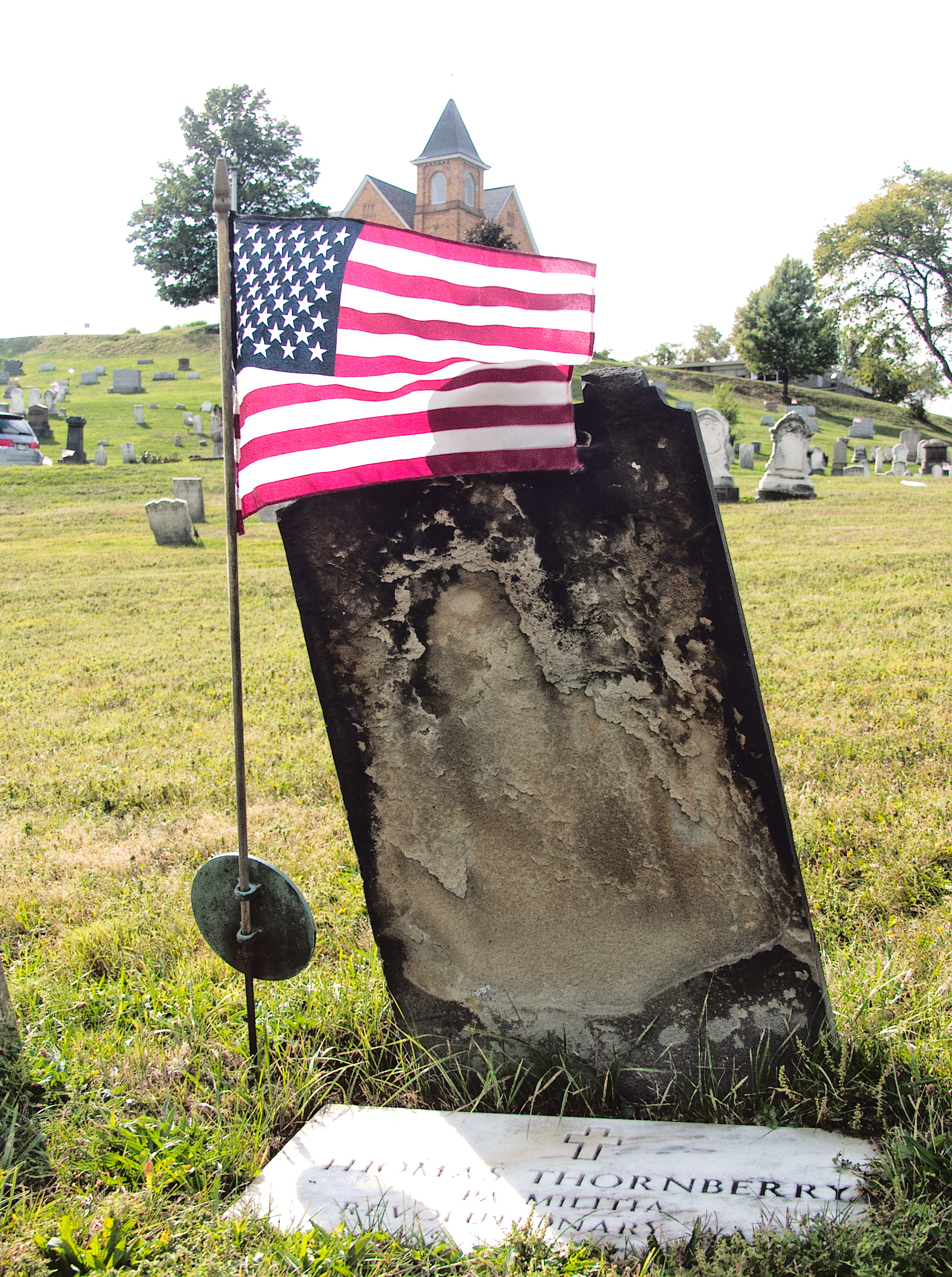
This stone is regrettably so badly damaged that we can read nothing on it. But a plaque in front of the stone identifies it as belonging to Thomas Thornberry, a Revolutionary War veteran. Presumably the name is entered thus in the burial records.
Beside his stone is a legible stone for a woman who is obviously his wife.
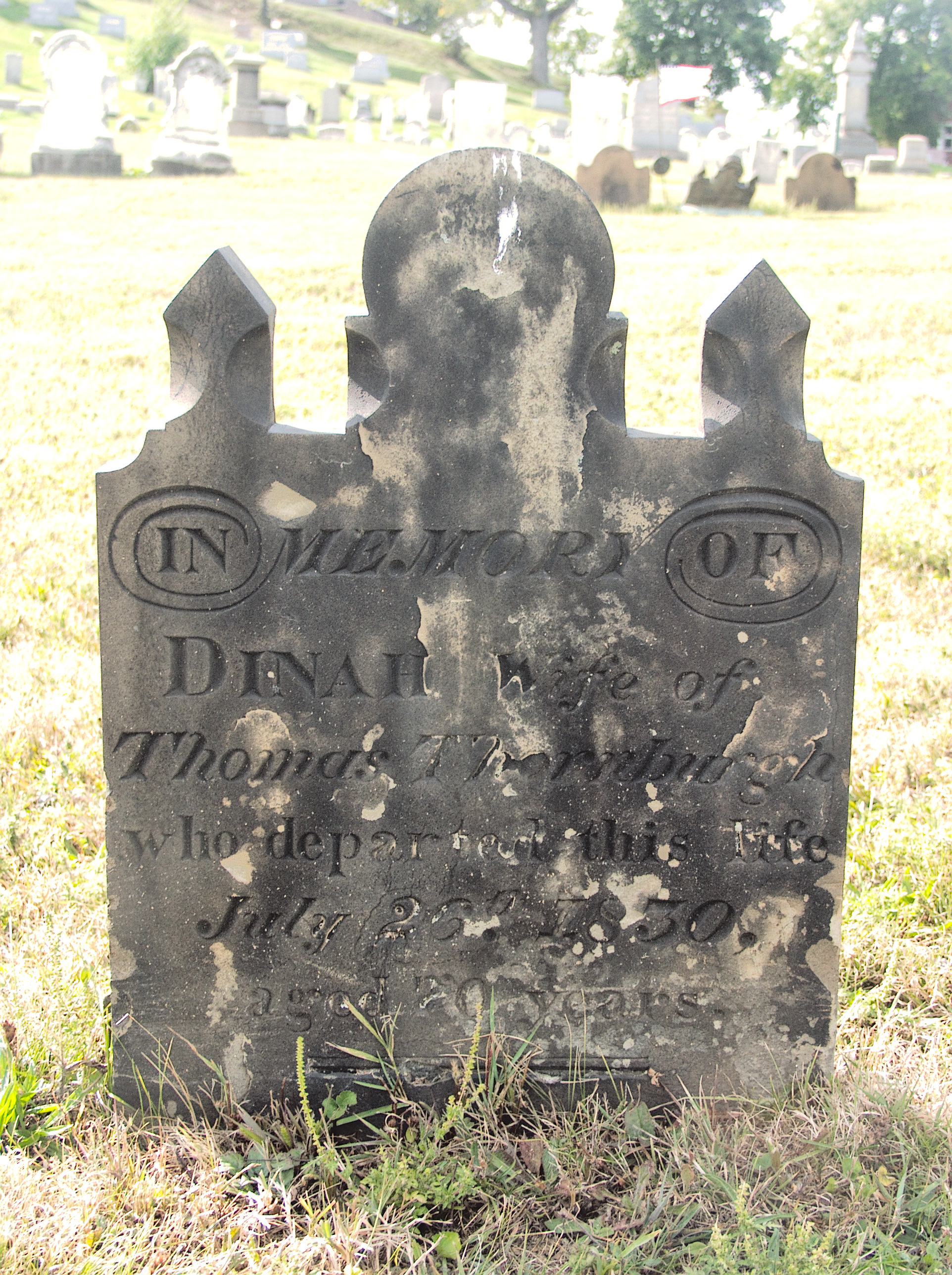
IN MEMORY OF
DINAH Wife of
Thomas Thornburgh
who departed this life
July 26th, 1830,
aged 70 years.
And here is our evidence. Inscriptions on tombstones of the early 1800s around here are commonly semi-literate; it is common to find variant spellings of the same name. Here we have the same name spelled “Thornburgh” and “Thornberry.” Now, it is not possible to imagine the name “Thornberry” being pronounced “THORN-burg,” but it is quite possible to imagine “Thornburgh” passing from “THORN-burrah” to “THORN-berry” in the rural American accent of two hundred years ago. And if that is the case, then we have evidence that, in western Pennsylvania, the spelling “-burgh” indicated the sound “-berry” at least to some residents as late as 1830.
But the residents of the borough themselves might have regarded that pronunciation as the mark of a hick. I’ve been reading Hugh Henry Brackenridge’s Incidents of the Insurrection in the Western Parts of Pennsylvania in the Year 1794, which is a riveting story of the Whiskey Rebellion told by a very clever man. One of the things you can’t help noticing is the wide cultural difference that already existed between Pittsburgh and the surrounding countryside. Pittsburgh was already developing urban sophistication of a sort, and the country people hated it. How will we prevent them from burning Pittsburgh?—that’s the constant anxiety of people in town. It was clear that a large portion of the mob was ready to use the revolt against the whiskey excise as an excuse to loot and destroy the borough, taking their revenge on all those people who thought they were better than honest country folk. In one telling episode, Brackenridge and his town friends have a good laugh at an illiterate notice posted by a country rebel in a tavern—only to turn and find two or three country people seething with resentment. As usual, Brackenridge saved his skin with a joke. “I turned it off suddenly, by saying, that it was no matter; he did not spell well; but he might be a good soldier, and sight well. This restored their good humour.”
All of this is speculation on top of speculation on top of a molehill of evidence. But speculation is most of what you will see here, so you might as well get used to it.