The Idea of a Hospital a Century Ago

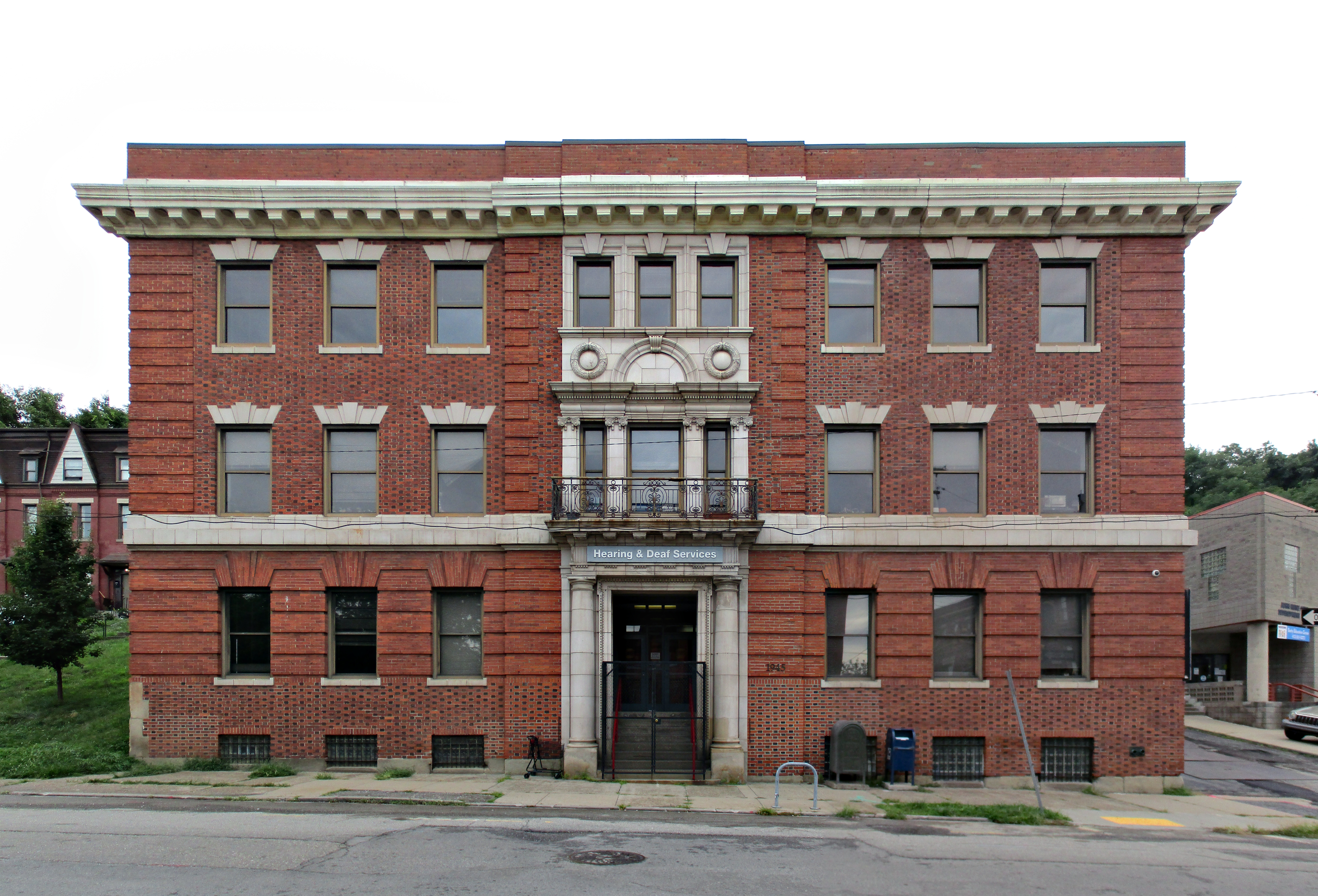
The building on Fifth Avenue still stands today, though no longer in use as a hospital.

How the idea of a hospital has changed is made strikingly clear by this description of the Eye and Ear Hospital from a 1922 history of Pittsburgh.

Located on Fifth avenue, corner of Jumonville street, is the Eye and Ear Hospital, under the auspices of a board of women managers. It had its inception at a meeting held May 20, 1895, at the home of Miss Sarah H. Killikelly, who during her lifetime was well known in the literary and historical circles of the city. A charter was secured June 22, 1895, and a location was secured on Penn avenue, but a removal was made to the present building in 1905. The first board of managers consisted of thirteen women and two physicians, eye specialists, for the medical and surgical treatment of all diseases of the eye, ear, nose and throat. The patients are divided into three classes—first, for the poor who require treatment of a character that is not necessary to detain them at the hospital; second, for the poor who require detention in the hospital, to whom free beds are allotted in the wards and a nominal charge made if they are able to pay; third, for those able to pay, private rooms are furnished, therefore the hospital is in no sense a charity; it must under its charter minister without charge to all those who suffer from any disease of the eye and ear, who are unable to pay for treatment.1

We might add that it would be interesting to survey hospitals today and find out how many of them are controlled by a board of women managers. There may be a few Catholic hospitals still nominally controlled by nuns.

  1. History of Pittsburgh and Environs, vol. II, p. 284. New York and Chicago: The American Historical Society, Inc., 1922.

An Experiment Interrupted

Does the imagination of a pregnant woman have a phys­ical effect on the child she is carrying? A certain English doctor was con­vinced that it did, and wrote a short book in refuta­tion of another doctor’s opinion that it did not. Unfor­tunately, how­ever, when he at­tempted to prove his thesis by experi­ment, he ran into difficulty.


Whilst I was writing the ensuing Refuta­tion, I thought I had the fairest Oppor­tunity that cou’d be wish’d, for begin­ning the direct Proof of the Ques­tion by certain Matter of Fact; but I was most unac­countably disap­pointed. There came an honest Country-Girl, to be House-Maid, where I then was, from whom I learnt, very unex­pectedly, this curious Par­tic­ular, relating to herself: That she was mark’d in the Neck with a Beef-Stake, because her Mother, when with Child, had longed for it; and that she could eat, nay, loved Beef raw, better than any wise dress’d , for the same Reason. She said moreover, that she would eat some in my Presence, whenever I pleased. Indeed the Mark had very much the Resemblance of a Beef- Stake.

Well, says I to myself, this happens very luckily for my Purpose; 1 must not let this Oppor­tunity slip: Ac­cordingly, the first Day we had Beef-Stakes, I went into the Kitchen: Come, says I to the Girl, let me see now, what you promis’d me. No, says the Cook-Maid, there’s none to be spared. Nay, says I, she must eat her Dinner. Well, but it must be broil’d a little, replied the Cook. The Girl seemed a little con­cern’d. At last she said, she was ready to eat it, with a little Pepper and Salt. Oh! says I, that shall break no Squares. So to eating she fell: Then came little Miss, who ask’d me, Whether I would make the Maid sick? Last of all comes Mrs. House-keeper, who tells me in a great Passion, You shan’t kill the Maid. In a Moment after the whole Posse of the Kitchen was ready to fall upon me; the whole House was in an Uproar; and, I believe, would have torn me to Pieces, if I had not made my Escape. This was very vexing; for the Girl had, by this Time, almost eat up the Slice she had cut off, and I had con­sented to, for the Experi­ment. After the Fury was over, I told them, that there was a great Contro­versy among Phy­sicians, upon that Sub­ject; that I had taken the Women’s Part, in a Dispute I once had with some Divines, upon that Head; that I had just flat­ter’d myself with the Hopes of con­vincing my Adver­saries, by that Matter of Fact; but that, since they had thus disap­pointed me, I must put off my Design till some better Opportunity.

This is a plain Nar­rative of my Adven­ture, without any Flourish or Disguise.

——Dr. Blondel Confuted: or, the Ladies Vindicated, with regard to the Power of Imagination in Pregnant Women, by John Henry Mauclerc, M.D., 1747.

A Rule and Instruction to Preserve Such as Be in Health, from the Infection

The plague hit London in 1603, and of course writers and printers were not slow to take advantage of the market for information that would prevent or cure the plague. In a blackletter tract, a physician explains the sound principle that you should stay away from infected persons as much as possible. Meanwhile, you can prevent the infection by making the world around you smell better. (Paragraph divisions have been added here; in the original there are none.)


When as (by the will of GOD) the contagion of the Plague is gotten into any place, Citie, or Countrey; we ought to have an especiall regard of the generall good, and by all meanes to study for their preservation who are in health, least they fall into such inconveniencie. First of all, therefore it behooveth every man to have speciall care that he frequent not any places or persons infected, neither that hee suffer such to breath upon him: but as Galen hath learnedly advised, in his Booke De Differentijs Frebrium, Chap. 2. Estrange himselfe as farre as hym lyeth, from their societie. The first and chiefest remedie then, is to chaunge the place, flie farre and returne late: Hipocrates, likewise in his Booke De Natura humana, saith: that wee ought to forsake the place whereas a generall sicknesse rangeth, according to the common Proverbe, Cito, longe, tarde.

And if necessitie constraineth us to frequent the infected, (either to be assistant to our friends, or otherwise:) every man ought to demeane himself in such sort that the sick mans breath doo not attaint him: which may very easily be done, if a man have the skill to choose & take the winde that properly bloweth towards the sicke & infected, and not from the infected to the healthfull: And therefore in that case the healthfull ought to keepe themselves under, not over the winde.

The first part of preservation, is to purifie and purge the ayre from all evill vapours, sentes, stench, corruption, putrifaction, and evill qualitie. For which cause, it is necessary to make good fumes in our houses, of sweet and wholesome wood, as Rosemarie, Iuniper, and Lawrell, or Bayes, and to perfume the whole house and chambers with the fume of Rosemary, Iuniper the parings of Apples, Storax, Beniamin, Incence, dried Roses, Lavender, and such like, both Evening and Morning. It is not amisse likewise at every corner of the street, (at least twice in the week) to make cleare and quicke Bonefires to consume the malignant vapours of the ayre, according as Acron the great Phisitian, commaunded to be done during the mortall plague in Greece: As Paulus Aegineta testifieth in his second Booke, Chap. 35.

It is good also to wear sweet savors and perfumes about us, such as in Winter time, are Marcorame, Rosemarie, Storax, Beniamin, or to make a Pomander after this sort that ensueth, and to weare it about us to smell too upon all opertunities.

Take of the flowers of red Roses, of Violets, of Buglos, of each half a little handfull, of the three Sanders, of each a Dramme, of the rootes of Angelica, Gentian, and Zedoary, of each four scruples; of white Encens, Cloves, Nutmegs, Calamus, Aromaticus, of each a dram, of Storax, Calumit, and red Beniamin, of each a dramme and a halfe, of orientall Muske a scruple, of Amber-greece halfe a scruple, of Ladaum infused in Rose-water one ounce, mixe all these together in Rose-water where in the Gum Dragacanth hath beene infused, and with a little of Rose-vinegar make a paste, of which you may forme certaine rounde Pomanders, to weare about your necke, and smell unto continually.

Or take of Rose-water three ounces, of white Vinegar, of Roses ij. ounces, of white Wine, or pure Malmosie two spoonfuls, of the powder of Cloves, of the roote of Angelica and Storax of each halfe a dramme, mixe them all together, and with this liquor it shall not be amisse to wash your hands, bedeaw your forehead & nostrils, and the pulces of your armes, for such an odour and of so wholesome a qualitie, vehemently repulceth the venome that assaileth the heart, and altereth the pestilence of the ayre.

——From A Treatise of the Plague, by Thomas Lodge. London: Edward White and N. L., 1603.
Disinfectants

Worcester’s Dictionary (1848 edition) defines “infection” as “the propagation of disease through the medium of the air.” “The simple theory of disinfectants” is that air that smells bad carries disease, and that eliminating the bad odor will therefore eliminate the infection. It would be wonderfully consoling if the theory were true.


Disinfectants.—Do our lady readers understand the simple theory of disinfectants? Every housekeeper has had occasion to use chloride of lime: half a pound to five gallons of water, is the quantity recommended by a very able chemist. Aromatic vinegar poured upon a heated iron plate is perhaps the pleasantest of all, though not always to be had, or remarkably economical. The cheapest, and, at the same time, one of the most convenient and agreeable of all, is common coffee. Pound the well-dried raw bean in a mortar, and strew the powder on a moderately heated iron plate. Just traversing the house with a roaster containing freshly burned coffee will clear it from all offensive smells.

——From Godey’s Lady’s Book, July, 1852.